
by Davina Best
At our AGM in November 2025, Peter Sherlock gave an entertaining description of how we found who the parents of Tom White Melville Winder using a combination of genetic DNA research and traditional archival work.
If you missed the details, Tom White Melville Winder was born in Cambridge in 1787 as plain old Thomas Winder to William Winder and his wife Mary Norman. William was the Cook of Magdalene College in Cambridge University. His son Thomas probably grew up doing food deliveries for the College’s Fellows and students – a prototype of UberEats as Peter quips. You’ll be able to read more about this in Peter’s upcoming book on Tom Winder’s life and origins.
Importantly, Tom Winder was not a son of the Duke of Wellington or a Lady Melville. This story seems to have emerged in the family somewhere around the 1870s or 1880s and caught everyone’s fascination.
The Correct Family Tree
We are now requesting descendants to update your family trees in Ancestry or MyHeritage or anywhere else online with the correct information. You will help set the record straight – and you might find some new DNA discoveries to share with us.
The image below shows Tom’s parents William Winder born 1754 and Mary Norman born about 1752, along with William’s siblings and their spouses. We don’t know the ancestry of Mary Norman yet.
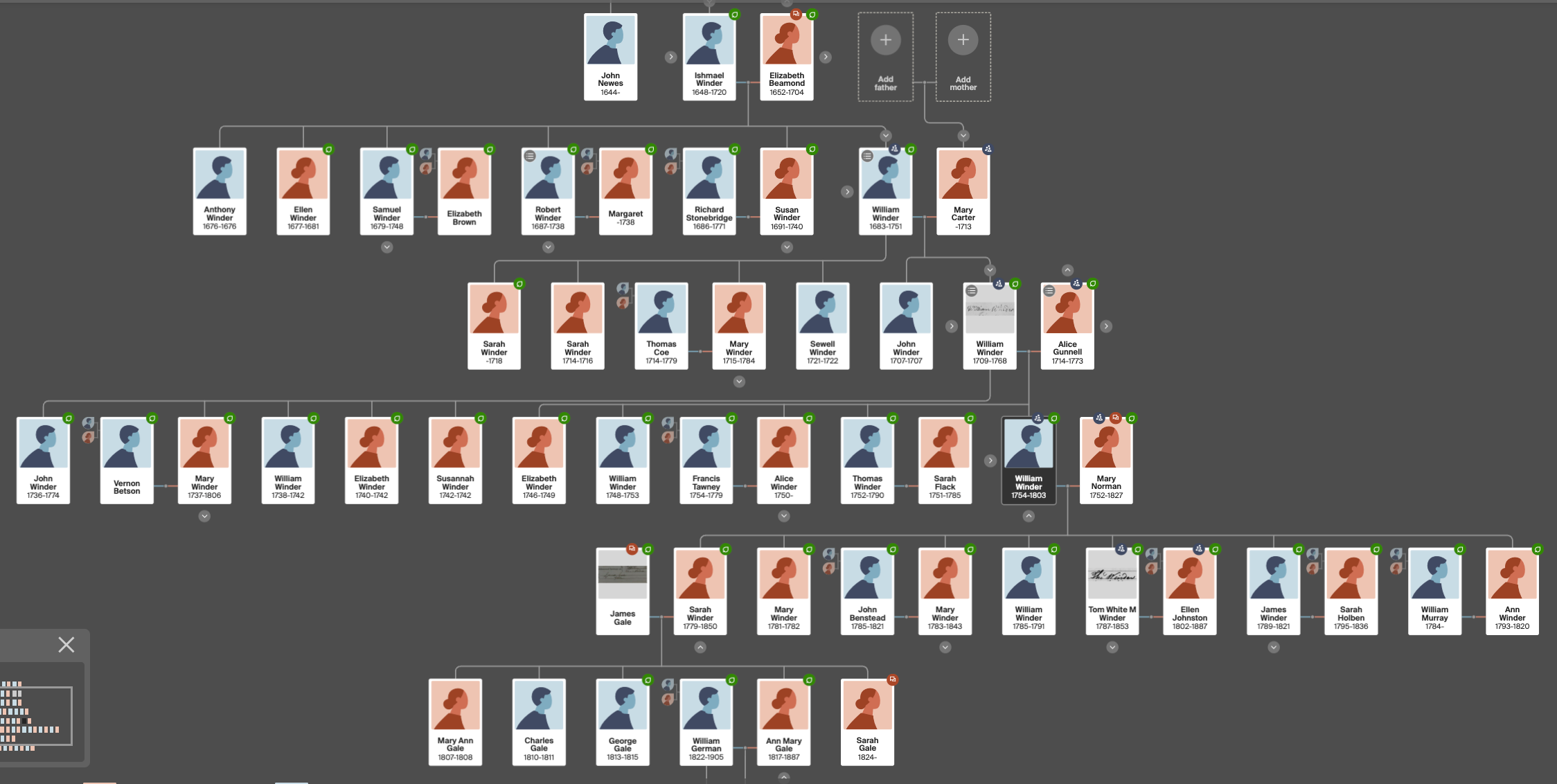
You can also consult and copy Peter Sherlock’s family tree which is public on Ancestry. https://www.ancestry.com.au/family-tree/person/tree/6817635/person/-1219867462/facts
The DNA Discovery and Confirmation
How did we discover this? We came across a small cluster of DNA matches in AncestryDNA who matched several descendants of Tom Winder and Ellen Johnston. When we traced their family trees back several generations, we found that they were all descended from a William German and Ann Gale who lived in Cambridge in the mid 1800s. Peter checked his extensive spreadsheet of every Thomas Winder born around 1787 in England and found he had one born in Cambridge in 1787. This was the first time he thought he might finally have the right Thomas Winder.
We concluded from the various DNA matches that the connection was through the Gale line. You can see Ann Gale on the bottom line of the tree above. Ann Gale was the daughter of a James Gale and his wife Sarah, of unknown surname. Peter guessed that Sarah might be the link.
(I want to point out that Peter is not keen on guesses. There are thousands of incorrect family trees based on incorrect guesses. But I pointed out this was really an educated guess after all his years of experience scouring for records.)
Eventually, Peter found a marriage record for an Ann Winder and William Murray signed by James and Sarah Gale, and a marriage record for a Mary Winder and John Benstead signed by Thomas Winder. They seemed to be siblings witnessing each other’s marriages, and Peter concluded that Sarah Gale was the sister of this Thomas Winder and mother of Ann Gale who married William German.
But how could this be proved? We had barely found these remote cousins in AncestryDNA. But we knew we could test the male line of Thomas with Y-DNA which spans many generations. We had seen with the Knight Hungerford Y-DNA a few years earlier.
Peter traced up the male line from Thomas Winder to a man named Ishmael Winder born in the village of Histon, just north of Cambridge, in 1648. Ishmael appears to have been born outside of marriage to Margaret Winder. So Peter traced down all the male lines from Ishmael. Apart from our Tom Winder, every single male line died out with one exception: Ishmael’s great-great-grandson Samuel Winders (not Winder) who was born in 1820 and emigrated – would you believe it – to Queensland, Australia.
Peter identified there was just a handful of male Winders descendants still living in Queensland, so I looked in Ancestry and sent messages through Facebook – to no avail. Finally I resorted to the Whitepages and rang the most likely match. (Since then the Whitepages has stopped showing residential numbers, so we were just in time). A charming 85 year old man answered and told me what he knew about his grandfather who had come from England.
More unbelievably, he agreed to do a Y-DNA test – which gives the male-line ancestry alone – so I posted that package off in a flash and a few weeks later, with a few reminders, he did the test.
We started with the cheaper Y-37 test to see if we got any match with the tests done by two of the last surviving male line descendants of Thomas Winder. This was a long shot as we were looking for a match between men who shared a possible ancestor 9 generations over 350 years earlier. Astonishingly, the tests matched.
With financial support from the HAFS Committee, we upgraded to the Big-Y test. This test uses newer technology and gives far more detailed information about the likely time when the most recent common ancestor was alive. This provided a conclusive result: the descendants of Tom White Melville Winder of New South Wales, and of Samuel Winders of Queensland, shared a male-line ancestor born somewhere around the 1630s and 1640s. This matched perfectly with Ishmael Winder born at Histon in 1648, and the paper trail Peter had followed to trace his descendants. There is no doubt at all that Tom White Melville Winder was the Thomas Winder born in Cambridge in 1787.
The irony of this result, of course, is that Thomas Winder’s male-line Winder ancestry only goes back to 1648. Who was Ishmael Winder’s father, and what was his surname? Future Y-DNA matches could well help us find a result as more males take the test. Meanwhile we can report that through Ishmael Winder’s mother, Margaret, we can trace Thomas Winder’s ancestry back to a Christopher Winder who died at Histon in 1588.
What does all this tell us?
First, question the family stories. Look for proof. The story of the Duke of Wellington had no records or DNA matches to support it. DNA doesn’t tell lies or make up stories. Sort through the facts and in the end you’ll find records that support the facts and tell some stories.
Secondly, be systematic and patient. Peter’s thorough collection of records and building an accurate tree were essential. In fact, the process of elimination for this project was made easier by all the work that has gone into HDU – the records that Peter started over 30 years ago , and that Pauline and the Committee have systematically continued to this day. We did our own DNA tests in 2017 or earlier, then asked a few Hungerford Winder descendants to do some shortly after. But we’ve had to wait for years to get matches from people in the UK and Canada and Australia, who filled in the DNA jigsaw puzzle enough for us to see the clues.
Thirdly, think of the different DNA tests as tools. Ancestry and MyHeritage cast a wide net, but Y-DNA, mtDNA and X-DNA allow you to cut through or make leaps that Ancestry can’t do. Use them together. Peter and I also Ancestry’s ProTools, Ancestry’s ThruLines, chromosome browsers and modelling tools to get clues and validate our ideas.
Finally, collaboration works wonders. We bounce ideas off each other, and correct each other’s thinking. We gain huge insights when people share a DNA kit with us. We’re so grateful to some of the people in our clan here in Australia and the remote cousins we’ve discovered in the UK, Canada and US. They’ve shared their knowledge and the love of family history when they barely knew us, and we’ve made friendships and correspondences that have gone on for years as a result.
The DNA journey is fascinating, but a learning curve. Join us on the journey as we tackle some new projects.
If you have questions or comments, please contact us through the website form and choose DNA enquiry.
Related Articles
-

When I was researching the ancestry of my husband John Wilton [E.2.2a.2b.4c.2d.1e=], I looked into Trove to find out more about his Arabin ancestors. The…
-
This article was written by our founder Ron Prentice more than 20 years ago, (HAFS Journal Vol 5 No 3 – May 2000) but it…
-

University of Divinity Chancellor Dr Graeme Blackman AO announced on 8 September 2023 that Professor Peter Sherlock [E.4.1a.6b.5c.1d.2e] will step down as Vice-Chancellor in March…